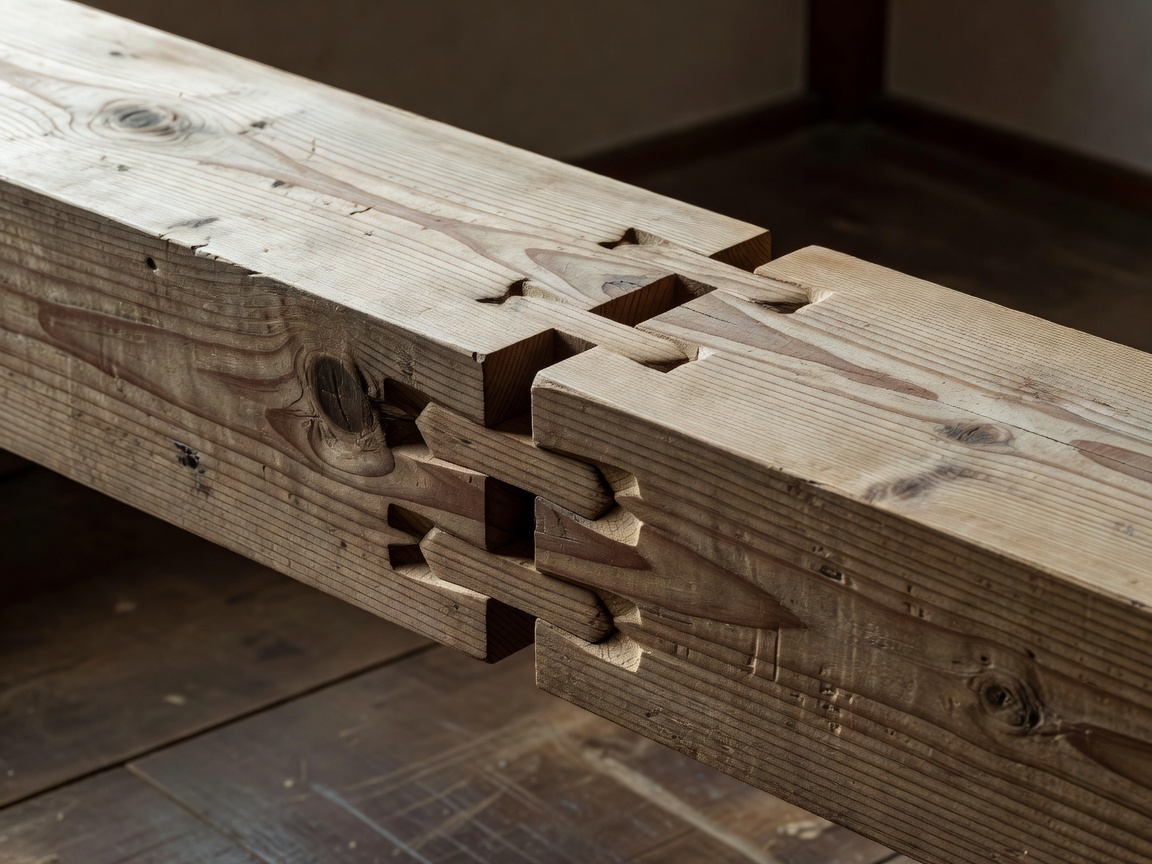
Introduction to Kanawa Tsugi (金輪継ぎ)
In traditional Japanese architecture (Kigumi), metal fasteners, bolts, and modern polyurethane adhesives were historically avoided due to corrosion risks and structural rigidity issues during seismic events. Among over 400 specialized traditional joints, Kanawa Tsugi (the halved blind-keyed scarf joint) stands out as one of the most mechanically sophisticated methods for extending heavy vertical columns and horizontal sill beams.
Anatomy and Geometry of the Joint
The elegance of Kanawa Tsugi lies in its geometric symmetry. Each timber end is cut into an identical stepped profile featuring:
- Blind Shoulders: Prevent lateral movement and direct shear displacement.
- Inclined Friction Planes: Cut at precise angles (typically 1:10 slope) to create wedge clamping force as the joint seats.
- Central Key Channel (Komase Mortise): A rectangular slot cut precisely at the center where two tapered oak or hornbeam keys are driven from opposite sides.
Load Transfer Under Seismic Flexure
Modern structural testing shows that rigid steel plates concentrate stress at bolt points, causing fiber shear along the grain during earth movement. Conversely, a Kanawa Tsugi joint allows micro-compressions across the end-grain faces. The central key absorbs shock loading by slight elastic compression, preventing catastrophic splitting.
Practical Layout and Sawing Steps
To execute a tight Kanawa Tsugi joint by hand:
- Select stable straight-grain timber (Hinoki Cypress, White Oak, or Douglas Fir) free of knots along the joint section.
- Layout dimensions using a Sashigane (Japanese steel square) and Kebiki (marking gauge) for sub-millimeter precision.
- Saw shoulder lines using a fine-toothed Dozuki back saw to prevent tear-out.
- Chisel out internal mortises with heavy-duty Oshi-nomi framing chisels.
- Drive keyways tightly with a hardwood mallet to draw both timbers into absolute contact.